Table of contents
.png)
Unstructured talk turns time into “documentation debt”
Here’s the pattern:
- A meeting happens.
- The conversation is useful—in the moment.
- The output is messy: a doc, a transcript, scattered bullets, or nothing at all.
- Two days later, the team re-litigates the same topic because nobody can find what was decided.
That gap between “we discussed it” and “we can prove it” is documentation debt. And it grows interest.
The articles call out why: teams still rely on static notes—docs, transcripts, minutes—text that doesn’t update systems, assign owners, or surface commitments when they matter. So the burden shifts back onto humans: someone has to remember, translate, retype, and chase.
That’s not admin work. That’s a hidden rework loop.
And it gets worse in modern environments where people are interrupted constantly. Microsoft’s “infinite workday” research is cited as ~275 nudges/interruptions a day. In that context, an unstructured conversation isn’t just “free-flowing.” It’s fragile. It won’t survive contact with Tuesday afternoon.

The “action gap” is real—and it’s where projects go to die
Most teams don’t struggle to talk about work. They struggle to convert talk into:
- decisions that stick
- commitments with owners
- deadlines that show up in the tools where work happens
Static notes don’t do that. A note doesn’t update Jira, assign tasks, remind you next Wednesday, or log a CRM follow-up. So people leave meetings with a false sense of closure—then discover a week later that nothing moved.
This is the core cost of unstructured conversation: it creates ambiguity that feels like alignment.
And ambiguity scales beautifully. The bigger the org, the more expensive it gets.
A simple way to see the cost
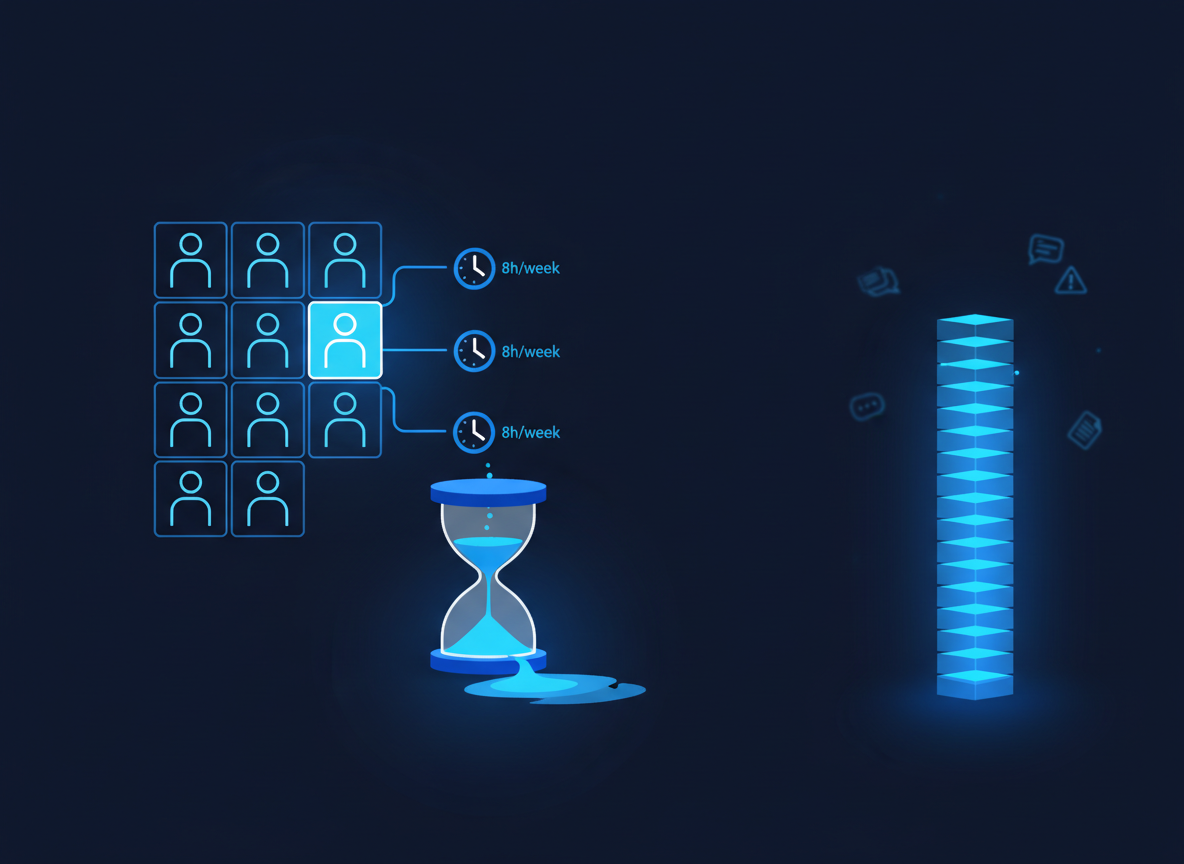
Take a 10-person team where each person spends 8 hours/week in meetings (not crazy given 20–35% of a 40-hour week). If even 15% of that meeting time fails to produce clear, retrievable decisions and tasks, that’s:
- 10 people × 8 hours × 15% = 12 hours/week of “meeting output loss”
- ~624 hours/year (at 52 weeks)
That’s before you count the second-order costs: follow-up meetings, Slack back-and-forth, duplicated work, missed deadlines, and risk.
Most organizations measure meeting time. Almost nobody measures meeting yield.
Information scavenger hunts are not a side problem—they’re the operating system
Unstructured conversation doesn’t just vanish. It fragments.
Outcomes scatter into email threads, Slack, shared drives, personal notes, and “that PDF someone swore was in the folder” .. The result: people spend a shocking amount of time searching instead of doing.
The articles cite research like:
- knowledge workers burning up to 30% of their week hunting for scattered information.
- 2.8 hours/week searching for what they need (one study) and up to 2 hours/day (another).
- 47% of digital workers struggling to find information.
That’s not a tooling issue. That’s a conversation-structure issue.
Because when conversations are unstructured, the outputs are unstructured. And when outputs are unstructured, search becomes a job.
Unstructured conversations create “shadow workflows” (the stuff nobody admits they do)
Every org has them:
- the spreadsheet one person maintains because the official system is always out of date
- the Slack DM network where real decisions happen because meetings are performative
- the post-meeting “translation layer” where a senior IC rewrites the chaos into tasks
These are survival mechanisms. They’re also a tax on your best people.
One of the articles points out that repetitive admin can eat more than half a person’s day, contributing to burnout. This matters because unstructured conversations don’t just create messy notes—they create manual glue work: copying, pasting, rewriting, assigning, reminding, updating systems.
And here’s the punchline: teams often think that glue work is “communication.” It isn’t. It’s unpaid operations.
.png)
The real risk isn’t inefficiency—it’s organizational memory loss
Unstructured conversation is how you end up with:
- “We used to have a reason for that rule, but nobody remembers.”
- “Didn’t we decide this last quarter?”
- “Why is this feature scoped this way?”
This is the silent killer: context decay.
The second article calls the best AI meeting tools “team memory”—cross-meeting recall you can search weeks later. That’s not a nice-to-have. It’s how organizations avoid repeating expensive debates.
When memory fails, companies pay twice:
- once to make the decision
- again to remake it
And in regulated environments (finance, healthcare, procurement), memory loss becomes compliance risk: unclear audit trails, undocumented approvals, inconsistent customer commitments.
Why “better notes” isn’t the fix (and what actually is)
If your solution is “everyone take better notes,” you’re basically asking humans to be the integration layer between conversation and execution. That doesn’t scale.
Traditional note-taking methods help individuals think—outline, Cornell, mind maps, matrices, etc.. But organizations need more than cognition. They need conversion: talk → structured output → workflow.
That’s why the articles argue for interactive, actionable notes—notes that behave like part of the workflow, not souvenirs from a call. In this framing, the meeting artifact should be able to:
- turn a sentence into a task with owner + deadline
- update Jira/CRM/project boards automatically
- link to relevant prior meetings, PDFs, emails, and decisions so context travels forward
- push next steps into Slack/Notion/HubSpot so work shows up where teams already operate
This “activate” step is explicitly described as the last stage of modern AI meeting tooling: record → transcribe → summarize → organize → activate (sync into systems). That’s the difference between documentation and execution.
The hard numbers leaders should care about (and often don’t)
A few metrics that expose unstructured-conversation cost fast:
A) Meeting-to-work conversion rate
Out of all action items mentioned in meetings, how many become:
- a tracked task (with owner + due date) within 24 hours? If the answer is “we don’t know,” you’re leaking execution.
B) Rediscovery rate
How often does a team ask:
- “Can you resend that?”
- “Where is that doc?”
- “What did we decide?”
Given the stats above (up to 30% of time searching; 47% struggling to find info) this is usually higher than leaders assume.
C) Follow-up meeting ratio
How many meetings exist primarily because the last one didn’t land?
If you track it, you’ll find a chunk of recurring meetings are just decision-repair.
D) Commitment integrity
Pick 10 meetings. Extract every “we’ll…” statement.
How many were completed on time?
Unstructured conversations produce vague commitments; vague commitments produce missed deadlines.
What to do Monday (practical, not aspirational)
If you want to reduce the cost of unstructured conversations without turning everyone into process robots:
- Define “decision” and “action” formats
- Decision: what, why, who approved, date, impact
- Action: verb, owner, due date, dependency
This forces clarity even when the conversation is messy.
- Stop storing outcomes where work doesn’t happen If your team lives in Jira/Linear/Asana/HubSpot/Slack, then outcomes must land there automatically or immediately. Static docs are fine as archives, not as operational reality 1.
- Use tooling that turns raw conversation into structured, connected deliverables The articles describe module-based automation (transcription, decisions, action items, compliance reports, pitches) that transforms messy inputs into outputs teams can act on—without “prompting gymnastics” . Multi-format intake matters because context lives across audio, docs, emails, PDFs.
- Treat retrieval as a first-class requirement If people can’t find it fast, it doesn’t exist. The point of “interactive notes” is stitching context across meetings and documents so rediscovery stops being a daily tax.
The uncomfortable truth
.png)
Unstructured conversations are expensive because they feel like progress while producing ambiguity, fragmentation, and rework.
And the fix isn’t “more meetings” or “better minutes.” It’s building a workflow where conversations reliably become structured memory and executable actions—so the organization doesn’t have to keep paying to remember what it already said. Interactive notes, automation that activates next steps, and cross-meeting memory aren’t productivity gimmicks; they’re how you stop hemorrhaging time after every call.